

I’ve been thinking a lot about what’s happening in Minnesota and wondering how to best respond as a writer.
In my news reporting days, I got used to covering current events and liked knowing I could write articles that had the potential to inform and engage audiences. Writing was an antidote to the moments when I would have otherwise felt helpless in the face of difficult news.
As I moved away from day-to-day reporting and became executive director of a small nonprofit called Images & Voices of Hope, I was tasked with helping to develop a storytelling genre called restorative narrative. These narratives show how people and communities find resilience in the aftermath, or midst of, difficult experiences. They’re not fluff pieces that romanticize resilience but, instead, deeply reported stories that explore pain, sorrow, grief — and human determination in the face of all that.
Rather than sensationalizing what’s broken, or suggesting that it’s already been fixed, restorative narratives probe how people move forward amid the breakage. They reveal meaningful progressions — a fuller arc from heartbreak to hope, illness to wellness, suffering to survival.

I helped train journalists how to tell these stories, and I now teach my students about them as well. I consider my memoir SLIP to be a restorative narrative in that it documents my life as someone living in the middle place of eating disorder recovery, between acute sickness and full healing.
Readers’ reactions have reminded me that sometimes restorative narratives, with their emphasis on resilience rather than resolution, are more helpful than prescriptive lessons learned. People are yearning for stories about how to get through difficult times — not necessarily how to get over them.
Not every illness, tragedy, or trauma leads to a restorative narrative, and when we’re in the midst of suffering it can be hard to consider how we could possibly move forward. But even the mere prospect of progression can give us hope.
The restorative narrative genre dovetails with what Parker Palmer calls “the tragic gap — “between the reality of the moment and the possibility that something better might emerge.” Parker, a renowned author and educator, described it well in a podcast interview with Duke University’s Kate Bowler:
“We’re living inside of forces we cannot control. And yet our job is to keep putting one foot after the other in that tragic gap, attempting to achieve something better, something better, something better. So the gap between what is and what could and should be is huge. It will never close.”
Palmer went on to talk about how our job as humans is to stop ourselves from falling into extremes: “corrosive cynicism” (nothing will ever change!) and “irrelevant idealism” (everything will be fine!)
“Our job is to keep putting one’s foot after another and stepping forward in that tragic gap, doing what we can every day, recording it in our journal of tiny achievements and understanding that it counts,” Palmer told Bowler. “It matters because there is no social change in the history of humankind that has been accomplished in one fell swoop. Every one of them has been accomplished by a million tiny steps over … generations. And recovering our democracy is a generational job.”
I love so much of what Palmer had to say, and it makes me think about how every story we write, every poem we pen, every Substack post we publish, can be a tiny achievement, especially when shared. It can be one step forward in the tragic gap — a perpetual messy middle that isn’t easy or welcome but is integral to the human experience and demands our attention.

Palmer’s work is in conversation with Victor Frankl’s teachings about seeking meaning in dark times. Frankl, who’s best known for his book Man’s Search for Meaning, once said: “Between stimulus and response there is a space. In that space is our power to choose our response. In our response lies our growth and our freedom.”
I appreciate that Frankl used the word response instead of reaction. Reactions are impulsive; responses require thoughtful choices about how to act with intention.
Our responses to what’s happening in Minnesota could take shape in a number of different ways: volunteering, donating to local mutual aid groups, attending vigils, advocating for change, and, of course, writing.
These responses may not help us find meaning so much as illuminate the path on our endless quest for it as denizens of the tragic gap. Virginia Woolf spoke truth to this idea in her iconic book To the Lighthouse, in which she writes that “the great revelation” of life’s meaning never came to her. “Instead, there were little daily miracles, illuminations, matches struck unexpectedly in the dark.”
As writers, we can strike that match and offer up light in the darkness. We can explore hard truths and unanswerable questions through the written word. Over time, when the acute stages of violence, trauma, or tragedy have passed, we can seek out restorative narratives that pave the way for growth — the kind that comes with living inside the tragic gap instead of avoiding it or pretending it doesn’t exist.
This is the hard but necessary work of the writing life.
Related: Watch this recording of me and author Estelle Erasmus talking about restorative narratives and the messy middle of recovery. | Check out this Write-Minded/Memoir Nation podcast episode with Parker Palmer on writing to make the world a better place.

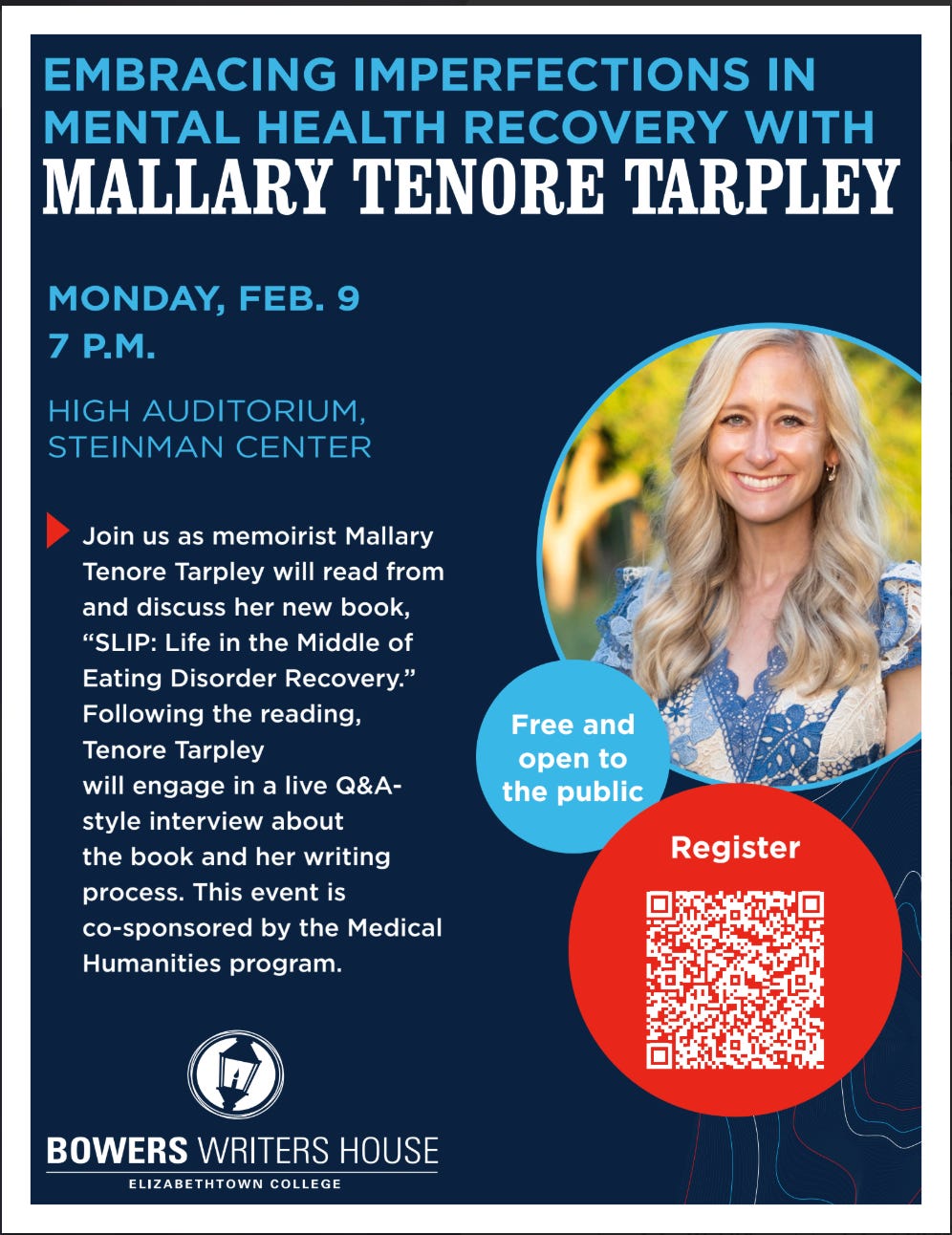
To my Pennsylvania friends: If you’re in the area, I hope you’ll join me for my next book event — at Elizabethtown College on Feb. 9 at 7 p.m. You can find more details in the image below. If you’re planning to attend, please be sure to register here. Hope to see you there!
Thank you for this, Mallary. It's so difficult to know how best to respond to the outrages happening every day in this country. This is a good reminder that our writing can be a form of response.
That Woolf passage is one of my favorites, too.
You quoted all my favorite people! :)